
The First Mirror
Passion dies with time. What keeps you going is discipline. What helps you win is ego.

"If you are not willing to risk the unusual, you will have to settle for the ordinary."
— Jim Rohn
I didn’t know this quote when I started my PhD six years ago. Even if I had, I’m not sure it would have meant anything to me then. It does now.
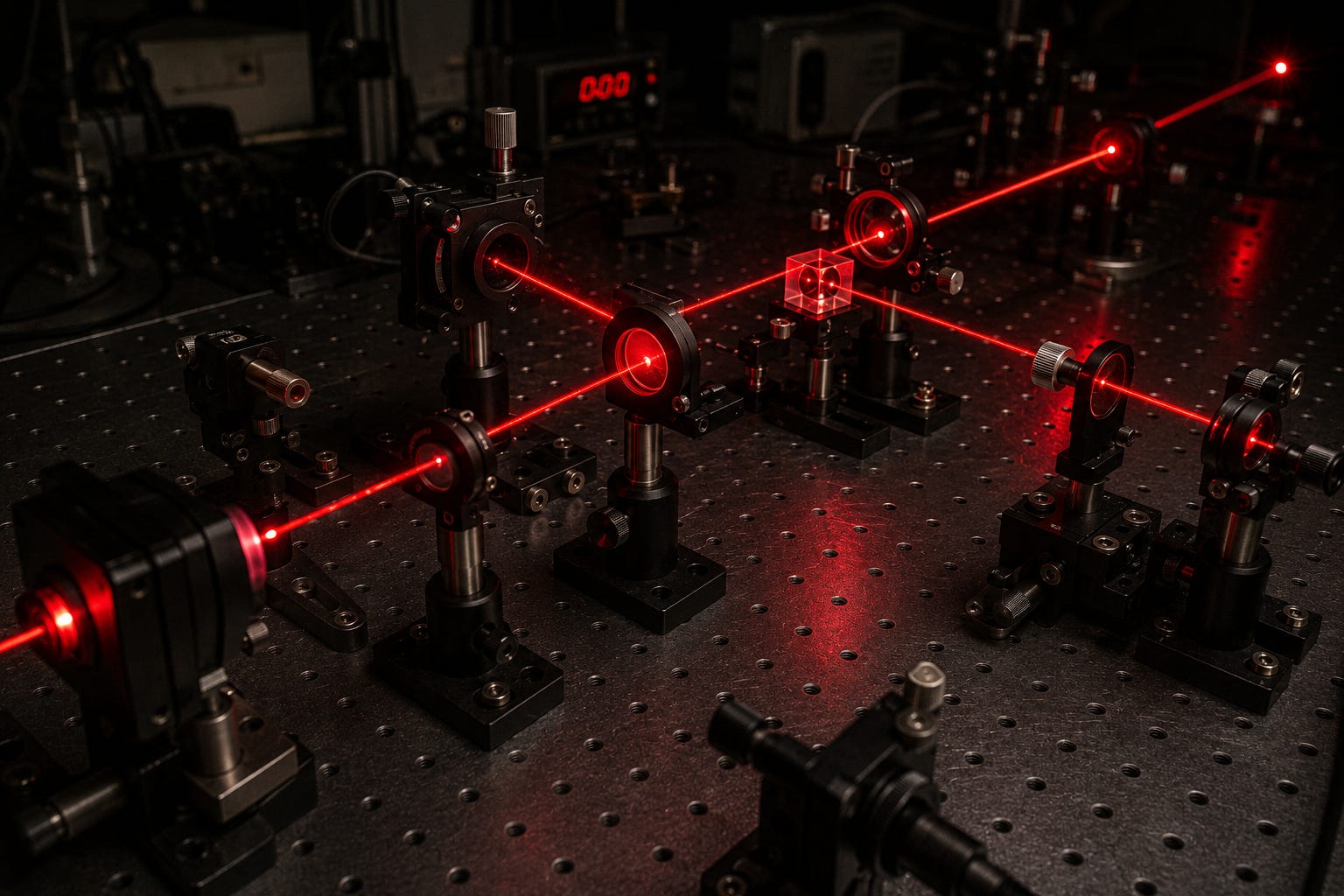
I didn’t know exactly what I wanted to work on when I chose my PhD. I just knew it would involve lasers.
That’s how ridiculous it sounds. Not a specific problem, not a clear research question. Just “lasers”. Something about that instrument, that field, felt right. I was chasing something because I knew it would make me happy. Looking back, that instinct was probably the best decision I made in the whole PhD.
When I joined the lab, we didn’t have a sitting room.
That’s where it started. Not with experiments, not with data, not with results. With a question of where to put a chair.
I had seen during my MSc what a new lab could offer. Fewer students mean more freedom. More freedom means more thinking. And more thinking, eventually, means more hands-on experience than you could get anywhere else. You learn to order optics and optomechanics. You remember item numbers. You know which component fits where, which mount works for which mirror, which cable talks to which controller. Nobody teaches you this. You just learn it because there’s nobody else to learn it for you.
So, I joined a lab that didn’t exist yet and started waiting for it to become one.
The first year and a half was mostly reading. Physics papers, mostly. I wrote code for data analysis, sharpened my programming, studied personal finance, did photography. The experiment itself was still theoretical. The laser hadn’t arrived.
In those months I also learned LabVIEW. Not from a course, not from a senior. I learned it because the electronics weren’t communicating with the delay stages and the existing code was broken. I stayed overnight and fixed it. At the time I was still figuring out what LabVIEW even was. That was the first thing I built that actually worked in that lab.
The optical table arrived before the laser. A massive table manually carried in and installed. I watched it happen. Just before I finished my PhD, a second table was installed, connected to the first, making an L-shape. The lab had grown. I had watched the whole thing from the beginning.
The laser was installed on 28th April 2022.
I wasn’t there. I was in Sikkim, somewhere in the mountains, on a trip I had planned months earlier. The thing I had been waiting for since I joined arrived while I was looking at a different kind of landscape entirely. It was installed that day without me.
I came back and we started aligning.
When someone aligns mirrors for the first time, only they know how frustrating it is. Either you’ve missed in the far field or the near field. Getting that almost perfect beam passing through the center of the mirror and going straight, that’s a remarkable experience. And you can only experience it once. After that it becomes daily life.
We started with an unknown sample. We got something. One spectrum, one data point. But we never figured out whether it was a real signal or detector saturation. That question is still open.
So, we moved to a known sample to verify. At least with a known sample we would understand what we were seeing.
We weren’t getting anything. We increased the power.
The sample burned.
After everything. After 1.5 years of waiting, after the table, after the laser, after the alignment. One moment of too much power and the sample was gone.
We waited more. Had a different sample, the last one. And then, finally, one spectrum. One data point from one sample after years of building something from nothing.
But one key component almost died, and we were left with whatever power it could still give. High power was no longer an option. It felt like the setup itself had decided, after burning that first sample, it simply wouldn’t let us go there again. But that’s research. Things might go terribly wrong, but you still keep going.
Here is something nobody tells you honestly: passion fades with time and failure. It doesn't disappear overnight. It just becomes quieter. What keeps you going is discipline. What helps you win is ego. A stubborn heart. At the end you can present the picture of a passionate researcher. But deep down you know you became disciplined because you were passionate at some point and that passion is what the discipline is quietly running on.
Working in the lab alone was the best part of my entire PhD. When you do something you love, half the stress disappears. When you join a new lab because you genuinely wanted it, half the problems feel like learning opportunities. You enjoy most of it.
But that comes with two tradeoffs. You watch other people progress rapidly in their work while you are stuck in a waiting loop: waiting for equipment, waiting for results, waiting for the experiment to cooperate. And when you seem sorted, when you seem to be enjoying what others find frustrating, people first don’t understand it. Then some of them start resenting it.
Both things happened to me.
What I know is this. From the first mirror to the L-shaped table. From broken LabVIEW code to a working experimental setup. From no sitting room to a lab that will keep running after I’ve left.
I built that. Not alone—but I was there from the beginning.
Most people never get to say that about anything.
I really appreciated this. What stood out to me was that the story did not begin with a breakthrough, but with an unfinished lab and the question of where to put a chair.
That made the whole piece feel grounded. The waiting, the broken code, the optical table, the laser arriving while you were away, the alignment, the burned sample, the single spectrum, all of it showed how much of research happens before there is anything clean to present.
I also liked the line that passion becomes quieter, and discipline keeps running on what passion started. That felt very honest. By the end, the real achievement was not only the result, but being able to look at the lab and know you helped build something that will keep going after you leave.